
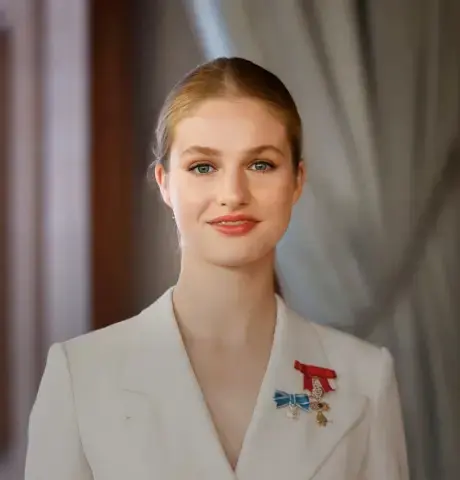

Leonor, Princess of Asturias, is the elder daughter of King Felipe VI and Queen Letizia of Spain and the first in line to inherit the Spanish throne. Beyond her best-known title, she actually holds six distinct royal titles, each tied to a different historic kingdom that came together to form modern Spain. This article breaks down every title Leonor holds, where each one comes from, when she received them, and how they connect to her broader preparation for the throne, including her recently completed military training across the army, navy, and air and space forces, which she finished in July 2026.
Quick Facts: Leonor’s Royal Titles
| Fact | Detail |
| Full name | Leonor de Todos los Santos de Borbón y Ortiz |
| Main title | Princess of Asturias |
| Full title set | Princess of Asturias, Girona and Viana; Duchess of Montblanc; Countess of Cervera; Lady of Balaguer |
| Titles granted | 19 June 2014, on her father’s accession to the throne |
| Formally proclaimed heir | 31 October 2023, her 18th birthday, before the Cortes Generales |
| Historical rank | 36th person to hold the title Princess/Prince of Asturias since its creation in 1388 |
| Origin of title | Granted by King John I of Castile to his son Henry III in 1388 |
| Regional style in Aragon | Princess of Asturias and Girona |
| Regional style in Navarre | Princess of Asturias and Viana |
Who Is Leonor, Princess of Asturias?
Leonor de Borbón y Ortiz is the heir presumptive to the Spanish crown. She was born an infanta on 31 October 2005, and her status changed on 19 June 2014, when her father acceded to the throne following the abdication of her grandfather, King Juan Carlos I. According to the official biography published by the Spanish Royal Household, that accession is the moment she inherited the full set of titles reserved for the heir to the Spanish crown.
Unlike many European titles that pass down a single, simple designation, the Spanish heir inherits a bundle of historic titles, each one representing a kingdom or principality absorbed into the unified Spanish monarchy centuries ago.
The Complete List of Leonor’s Titles
Leonor holds six titles in total. Her main, most publicly used title is Princess of Asturias, but the full set reflects the historic union of Castile, Aragon, and Navarre into modern Spain.
- Princess of Asturias is her primary title, representing the Crown of Castile.
- Princess of Girona representing the historic Crown of Aragon.
- Princess of Viana representing the historic Kingdom of Navarre.
- Duchess of Montblanc tied to the former Principality of Catalonia.
- Countess of Cervera tied to the historic Kingdom of Valencia.
- Lady of Balaguer tied to the historic Kingdom of Mallorca.
All six titles carry the dignity of Royal Highness, and Leonor received the complete set at once, on 19 June 2014, rather than accumulating them individually over time.
Princess of Asturias: Her Primary Title
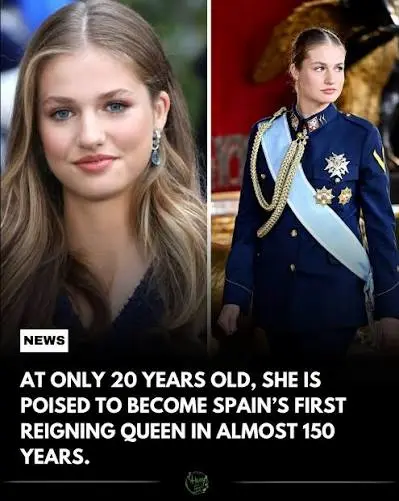
The title Princess of Asturias dates back to 1388, when King John I of Castile granted it to his son, the future Henry III, modelling it on the English tradition of naming the heir Prince of Wales. Leonor is the 36th person to hold this title since its creation.
The title is also attached to a real institutional role: Leonor is nominal chairwoman of the Princess of Asturias Foundation, which organises the annual Princess of Asturias Awards, one of Spain’s most prestigious international prize ceremonies, recognising achievement in the sciences, arts, humanities, and public affairs.
Historically, the title of Prince or Princess of Asturias was closely modelled on the English tradition of naming the heir Prince of Wales – a deliberate parallel between two mediaeval monarchies that both used a regional title to mark the heir apparent. Over more than six centuries, the title has been held by figures ranging from mediaeval infantes to the current monarch’s own father before his accession, making Leonor part of an unbroken chain stretching back to the fourteenth century.
Princess of Girona and Princess of Viana: The Aragonese and Navarrese Titles
The titles ‘Princess of Girona‘ and ‘Princess of Viana’ represent the two other mediaeval kingdoms whose union with Castile eventually formed modern Spain. Girona was historically the title of the heir to the Crown of Aragon, while Viana was originally the title of the heir to the Kingdom of Navarre, created in the fifteenth century by King Charles III of Navarre for his grandson.
- In the former territories of the Crown of Aragon, Leonor is formally styled “Her Royal Highness the Princess of Asturias and Girona”.
- In Navarre, she is styled “Her Royal Highness the Princess of Asturias and Viana”.
These regional styles are more than symbolic courtesy; they are used in official contexts within those specific territories, reflecting Spain’s historically layered monarchy rather than a single, uniform crown.
Duchess of Montblanc, Countess of Cervera, and Lady of Balaguer
The remaining three titles are less frequently used in everyday coverage but remain part of Leonor’s full legal style. Each has roots in the mediaeval Crown of Aragon, alongside Girona.
- Duchess of Montblanc dating to 1387, tied to a duchy in what is now Catalonia.
- Countess of Cervera dating to 1353, tied to a county historically associated with the Kingdom of Valencia.
- Lady of Balaguer dating to 1418, tied to a lordship historically associated with the Kingdom of Mallorca.
Together with Girona, these four titles reflect the full territorial reach of the old Crown of Aragon, all of which pass automatically to the heir alongside the better-known Asturias and Viana titles.
When and How Leonor Received Her Titles
Leonor’s titles were not granted gradually; she received the entire set at once the moment her father became king. Before that point, she held the more general title of infanta.
- 31 October 2005 – 19 June 2014: Styled “Her Royal Highness Infanta Doña Leonor”.
- 19 June 2014: Becomes Princess of Asturias and receives the full set of associated titles upon her father’s accession.
- 31 October 2023: Formally proclaimed heir before the Cortes Generales on her 18th birthday, swearing an oath to the Constitution.
The 2023 oath did not grant her any new titles; she had already held them for nearly a decade, but it was a significant constitutional milestone that publicly confirmed her readiness to serve as regent if needed, alongside the institutional preparation she was completing at the same time through her multi-year military training, which she began that same year.
How Her Titles Relate to the Line of Succession
It is worth distinguishing between Leonor’s titles and her constitutional position as heir. The titles are historic and ceremonial, tied to Spain’s mediaeval kingdoms; her status as heir presumptive is a separate constitutional fact, defined by Spain’s 1978 Constitution, which currently favours male heirs only in the event of equal proximity in the line of succession.
Because Leonor has no older brother, she is unaffected by this rule in practice and remains first in line regardless. If she eventually reforms to gender-neutral succession, which has been discussed in Spain but not enacted, her position would not change, but her younger sister, Infanta Sofía, would remain protected from ever displacing her, since Leonor was born first.
This distinction matters because it is common, even among Spanish media, to use “Princess of Asturias” and “heir to the throne” interchangeably. In practice, the title is the visible, historic marker of a status that is legally defined elsewhere, in the Constitution itself, meaning that even if Spain’s succession rules were reformed tomorrow, the titles themselves would remain unchanged in form, still tracing back to the same mediaeval kingdoms they have represented for centuries.
What Happens to Her Titles When She Becomes Queen?
When Leonor eventually succeeds her father, all six of her current titles will be absorbed into the crown itself, and she will become known simply as Queen of Spain. At that point, the title Princess of Asturias and its associated honours will pass to her own eldest child, continuing a tradition that has marked the Spanish heir for more than six centuries.
If that succession proceeds as currently expected, Leonor would become Spain’s first queen regnant since Isabella II, who reigned from 1833 to 1868, making her titles not just ceremonial curiosities but markers on a clear, historically resonant path toward the throne.
Why These Titles Still Matter Today
In an era when many hereditary titles are largely symbolic, Spain’s heir titles remain functionally significant. They are used in official documents, formal introductions, and regional visits, and the Princess of Asturias title in particular carries a real institutional role through the Princess of Asturias Foundation and its annual awards.
The titles also serve a quieter but important purpose: they visibly tie the modern constitutional monarchy to Spain’s deep, layered history, a reminder, every time Leonor is introduced in Girona, Navarre, or elsewhere, that the country she is set to lead was built from several older kingdoms, not a single unbroken line.
Comparisons are often drawn between Leonor’s title set and those used by other European heirs: the Prince or Princess of Wales in the United Kingdom, the Prince of Orange in the Netherlands, or the Duke of Brabant in Belgium. What sets the Spanish case apart is the sheer number of distinct historic titles bundled together: rather than a single regional designation, a Spanish heir inherits living reminders of at least six separate mediaeval territories, each with its own centuries-old lineage of holders.
Frequently Asked Questions
How many titles does Princess Leonor hold?
She holds six titles: Princess of Asturias, Princess of Girona, Princess of Viana, Duchess of Montblanc, Countess of Cervera, and Lady of Balaguer.
When did Leonor become Princess of Asturias?
She received the title on 19 June 2014, when her father, Felipe VI, acceded to the Spanish throne.
Why does Leonor have so many different titles?
Each title represents a different historic kingdom or territory – Castile, Aragon, Navarre, Catalonia, Valencia, and Mallorca – that united over the centuries to form modern Spain.
Is the Princess of Asturias the same as the heir to the throne?
The title and the constitutional status of heir presumptive are related but distinct; the title is historic and ceremonial, while her status as heir is defined by Spain’s 1978 constitution.
What was Leonor called before she was the Princess of Asturias?
From her birth in 2005 until her father’s accession in 2014, she was styled Her Royal Highness Infanta Doña Leonor.
Will Leonor’s titles change when she becomes queen?
Yes. Upon her accession, her current titles will be absorbed into the crown, and she will become Queen of Spain; the Princess of Asturias title will then pass to her own eldest child.
Conclusion
Leonor’s six royal titles are far more than ceremonial decoration; they trace the historic union of Castile, Aragon, and Navarre into the Spain that exists today, and they mark a status she has held since 2014, formally confirmed before Parliament on her 18th birthday in 2023. Alongside her education and her recently completed military training, these titles form one more concrete piece of Leonor’s long, carefully structured preparation to become Spain’s next monarch and, if current succession expectations hold, its first reigning queen in over one hundred and fifty years.
References
Casa de S.M. el Rey (Spanish Royal Household). “S.A.R. la Princesa de Asturias – Biografía.” https://www.casareal.es/ES/FamiliaReal/PrincesaLeonor/Paginas/biografia.aspx
Wikipedia. “Leonor, Princess of Asturias.” https://en.wikipedia.org/wiki/Leonor,_Princess_of_Asturias
Wikipedia. “List of titles and honours of Leonor, Princess of Asturias.” https://en.wikipedia.org/wiki/List_of_titles_and_honours_of_Leonor,_Princess_of_Asturias
Wikipedia. “Princess of Viana.” https://en.wikipedia.org/wiki/Princess_of_Viana
Royal Central. “History of Royal Titles: why is Spain’s heir known as the Princess of Asturias?” https://royalcentral.co.uk/features/history-of-royal-titles-why-is-spains-heir-known-as-the-princes
Wikipedia. “Princess of Asturias Awards.” https://en.wikipedia.org/wiki/Princess_of_Asturias_Awards
About the Author
This article was researched and written by the Royals & Culture Desk, a team focused on producing accurate, up-to-date explainers on European royal families, their history, and their public roles. All facts in this piece were verified against publicly available sources, including the official website of the Spanish Royal Household, as of August 2026.