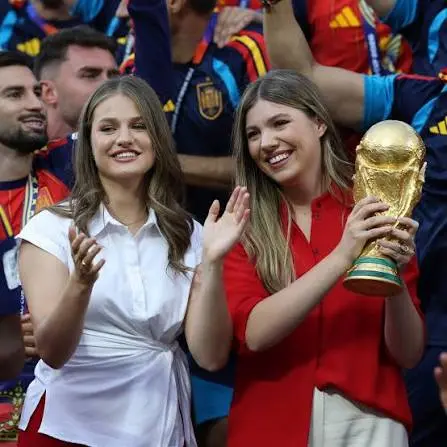

When Spain reached the final of the 2026 FIFA World Cup, the celebration was not limited to the football pitch. For the first time, King Felipe VI and Queen Letizia travelled abroad on an official trip together with both of their daughters, Princess Leonor and Infant Sofía. The occasion was Spain’s showdown with Argentina at the New York/New Jersey Stadium, a match that would decide the sport’s biggest prize.
The trip carried weight far beyond the scoreline. It placed Leonor, the heir to the Spanish throne, and her younger sister Sofía in an international spotlight that neither had experienced together with their parents on this scale before. For a royal family that tends to move carefully and deliberately in public matters, appearing as a unit on foreign soil, cheering for the national team, was a deliberate statement about the direction the monarchy is heading.
This article looks at why the trip mattered, what happened on the pitch, and what it signals about the growing public role of Spain’s two princesses as the country’s royal family continues to modernise its image on the world stage.
It also arrives at a moment when Leonor’s public profile is already rising quickly. Since completing stages of her military training, she has taken on a steadily fuller calendar of solo engagements inside Spain, and analysts following the monarchy have been watching closely for signs of how her international presence will develop. A World Cup final, watched by hundreds of millions of people worldwide, offered exactly that kind of stage.
A Historic Family Trip Abroad
Royal watchers were quick to note that this was uncharted territory. King Felipe and Queen Letizia had never before taken an official trip outside Spain with both Leonor and Sofía at the same time. Earlier in the year, the family had travelled together to Greece, but that visit followed the death of Princess Irene and was treated as a private family matter rather than an institutional engagement, even though it appeared on the official royal calendar.
The World Cup trip was different in nature. It was planned as a public, institutional appearance tied to Spain’s sporting success, which meant a different level of protocol, security planning, and media coordination. Travelling with two young royals to a major international sporting event in the United States required careful logistics, from motorcade routes to stadium security to managing public appearances around the match itself.
Spanish media outlets covering the palace also pointed out the practical side of the journey: coordinating a four-person royal delegation for a single-day sporting trip abroad involves far more than booking flights. Advance security teams typically scout stadium entry points, VIP boxes, and motorcade routes days in advance, while the palace’s communications office manages what images and moments are shared publicly versus kept private. None of that infrastructure is visible in the celebratory photographs that circulated afterward, but it forms the backbone of how a modern monarchy operates on the road.
Spain’s Road to the Final and the Extra-Time Triumph
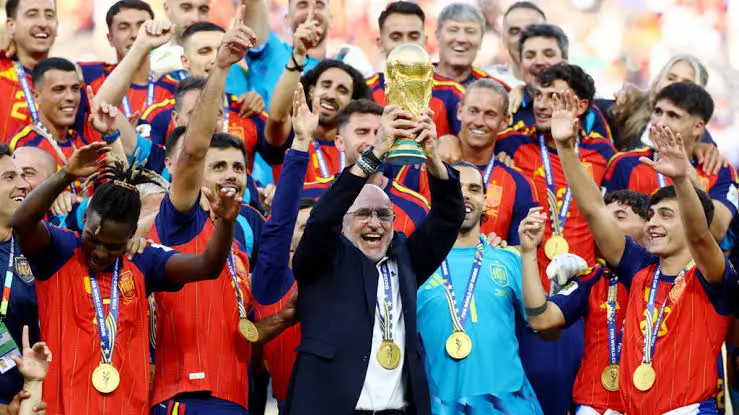
The football itself delivered a final worthy of the occasion. Spain, managed by Luis de la Fuente, faced an Argentina side still built around Lionel Messi in what was widely expected to be his last World Cup appearance. Spain had already shown their credentials throughout the tournament, and King Felipe had attended an earlier match in the competition, a group-stage clash against Uruguay played in Guadalajara, Mexico, underlining the family’s interest in the tournament well before the final.
The final itself, played on July 19, 2026, was tense and tightly fought. Spain dominated possession and shots on goal, but Argentina goalkeeper Emiliano Martínez produced a string of saves that kept the score level deep into the match. Argentina’s Enzo Fernández was sent off for a second yellow card in stoppage time, leaving his side to play the extra period a man down.
The breakthrough came early in the second period of extra time. Substitute Ferran Torres, who had only entered the match in the second half, pounced on a loose ball in the penalty area and fired it past Martínez to make it 1-0. The goal held, and Spain secured a 1-0 victory after extra time, claiming their second World Cup title following their first triumph back in 2010.
For the royal family watching from the stands, the moment of Torres’ goal turned New York/New Jersey Stadium into a wall of celebration in Spanish red. It was, by any measure, a memorable setting for Leonor and Sofía’s first joint appearance with their parents at a major sporting event of this magnitude abroad.
Leonor and Sofía’s Expanding Royal Roles
Princess Leonor has spent the past few years taking on steadily more formal responsibilities as heir to the Spanish crown, including military training and a growing schedule of solo public engagements. Infanta Sofía, while not first in line to the throne, has also become a more regular presence at official events alongside her parents and sister.
The World Cup trip fits into a broader pattern that royal commentators have tracked closely throughout the year: a gradual, visible expansion of both sisters’ public duties, both inside Spain and, increasingly, on the international stage. Appearing together as a family unit at an event with this much global viewership does more than mark a happy occasion; it signals to the public, and to other royal houses, that the next generation of Spain’s monarchy is being introduced with intention.
It also carries symbolic value at home. Spain’s royal family has worked in recent years to present itself as approachable and connected to everyday national moments, and few things unite the country the way a World Cup run does. By standing alongside millions of Spanish fans in celebrating the team, Leonor and Sofía were photographed sharing a moment of shared national identity rather than observing it from a formal distance.
Historically, Spanish monarchs have used major sporting occasions to reinforce a sense of national unity that can be harder to project through purely political or ceremonial events. King Juan Carlos I, Felipe’s father, was known for his own visible presence at major sporting events during his reign, and Felipe has continued that tradition since taking the throne. Bringing Leonor and Sofía into that tradition at this scale marks a deliberate continuation of a decades-long approach to royal public relations, updated for a generation that increasingly connects with public figures through global, shared moments rather than formal state functions alone.
Global Attention and What It Means for the Monarchy
International media coverage of the trip extended well beyond the sports pages. Royal-focused outlets picked up on the significance of the family’s joint appearance, framing it as a new chapter in how the Spanish monarchy presents its younger generation to the world. Coverage of the Winter Olympics earlier in the year had already put a spotlight on which European royals were choosing to attend major global sporting events, and Spain’s presence at the World Cup final added another data point to that pattern.
For a monarchy that operates under constant public scrutiny, these appearances are rarely accidental. Every joint trip abroad is weighed for its security implications, its diplomatic optics, and its impact on public perception of the royal family’s relevance. A World Cup victory, celebrated together as a family in a foreign stadium, gave Spain’s royals a moment of unmistakably positive, unifying publicity.
Looking ahead, royal watchers expect Leonor and Sofía to keep appearing at more high-profile international events as their public roles continue to grow. The World Cup trip may end up being remembered less for the football alone and more as an early marker of how the two princesses will represent Spain on the world stage in the years to come.
Comparisons to other European royal houses were inevitable in the days that followed. Coverage of the 2026 Winter Olympics earlier in the year had already tracked which monarchs chose to attend in person, from the Dutch royal family’s regular presence at speed skating events to Norway’s King Harald and Queen Sonja cheering on their athletes. Spain’s decision to send its full immediate royal family to a World Cup final, rather than a smaller delegation, stood out even against that backdrop, reinforcing how much importance the palace placed on the occasion.
Quick Facts: Princess Leonor at the 2026 World Cup
| Event | 2026 FIFA World Cup Final |
| Match | Spain 1-0 Argentina (after extra time) |
| Date | July 19, 2026 |
| Venue | New York/New Jersey Stadium (MetLife Stadium) |
| Goal scorer | Ferran Torres, 106th minute |
| Royal attendees | King Felipe VI, Queen Letizia, Princess Leonor, Infanta Sofía |
| Significance | First official trip abroad for the family with both daughters together |
| Result for Spain | Second World Cup title, after 2010 |
Frequently Asked Questions
1. Did Princess Leonor attend the 2026 World Cup final?
Yes. Princess Leonor travelled to New York with King Felipe VI, Queen Letizia, and her sister Infanta Sofía to attend Spain’s final against Argentina.
2. Why was this trip considered a royal first?
It was the first time the King and Queen travelled abroad on an official engagement together with both of their daughters, distinguishing it from earlier, more private family trips.
3. Who won the 2026 World Cup final?
Spain defeated Argentina 1-0 after extra time, with substitute Ferran Torres scoring the decisive goal in the 106th minute.
4. Did King Felipe attend other matches during the tournament?
Yes. King Felipe attended an earlier group-stage match between Spain and Uruguay in Guadalajara, Mexico, before the family’s joint trip to the final.
5. What does the trip suggest about Leonor and Sofía’s future roles?
Royal commentators see it as part of a broader pattern of both princesses taking on more visible public and international duties as Leonor prepares for her eventual role as head of state.
Conclusion
Spain’s World Cup final against Argentina will be remembered for a tense, extra-time battle decided by a single Ferran Torres strike. But for the country’s royal family, the trip to New York carried a second storyline: the first joint official appearance abroad for King Felipe, Queen Letizia, and their two daughters. Princess Leonor and Infanta Sofía stepped into a bigger, more visible role that day, one that royal watchers expect to become increasingly familiar as Spain’s next generation of royals continues to take shape on the global stage.
References
1. Hola.com — Princess Leonor and Infanta Sofía begin a new royal chapter at the World Cup Final in New York.
2. CBS News — Spain wins 2026 FIFA World Cup with a gruelling 1-0 victory over Argentina.
3. ESPN — Spain 1-0 Argentina (Jul 19, 2026) Final Score
4. FIFA.com — Spain v Argentina 1-0 | Result, Stats & Highlights | Final | FIFA World Cup 2026
5. Olympics.com — FIFA World Cup 2026: Spain-Argentina final score, lineups, live updates