
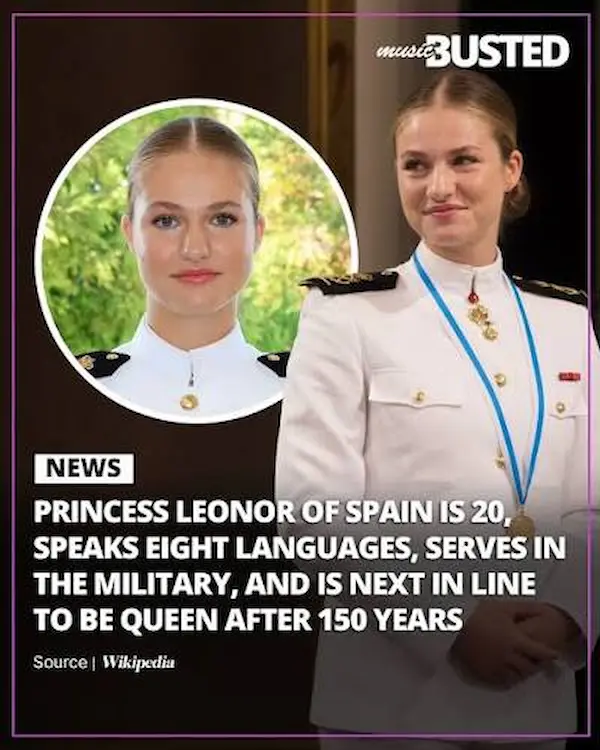

Leonor, Princess of Asturias, is the heir presumptive to the Spanish throne, first in line to succeed her father, King Felipe VI. Her position at the top of the line of succession has shaped nearly every stage of her upbringing, from her formal titles at birth to her military training and now her move into university. This article lays out exactly where Leonor stands in Spain’s line of succession, how that line is legally structured, who follows behind her, and what would happen if she were to become queen.
Quick Facts: Leonor’s Line of Succession
| Fact | Detail |
| Current position | 1st in line to the Spanish throne (heir presumptive) |
| Reigning monarch | King Felipe VI (her father) |
| Legal basis | Spanish Constitution of 1978, Article 57 |
| Succession rule | Male-preference cognatic primogeniture |
| Next in line after Leonor | Infanta Sofía (her younger sister) |
| Formal recognition | Swore allegiance to the Constitution on her 18th birthday, 31 October 2023 |
| Royal title | Princess of Asturias, plus five other historic titles of the heir |
| If she becomes monarch | Would become Spain’s first reigning queen since Isabella II (19th century) |
Who Is Leonor, Princess of Asturias?
Leonor is the elder daughter of King Felipe VI and Queen Letizia, born in 2005 during the reign of her grandfather, King Juan Carlos I. When her father acceded to the throne in 2014 following Juan Carlos’s abdication, Leonor was granted the full set of titles traditionally held by the heir to the Spanish crown, with Princess of Asturias as the primary one. Her younger sister, Infanta Sofía, was born in 2007 and stands second in line behind her.
How Spain’s Line of Succession Works
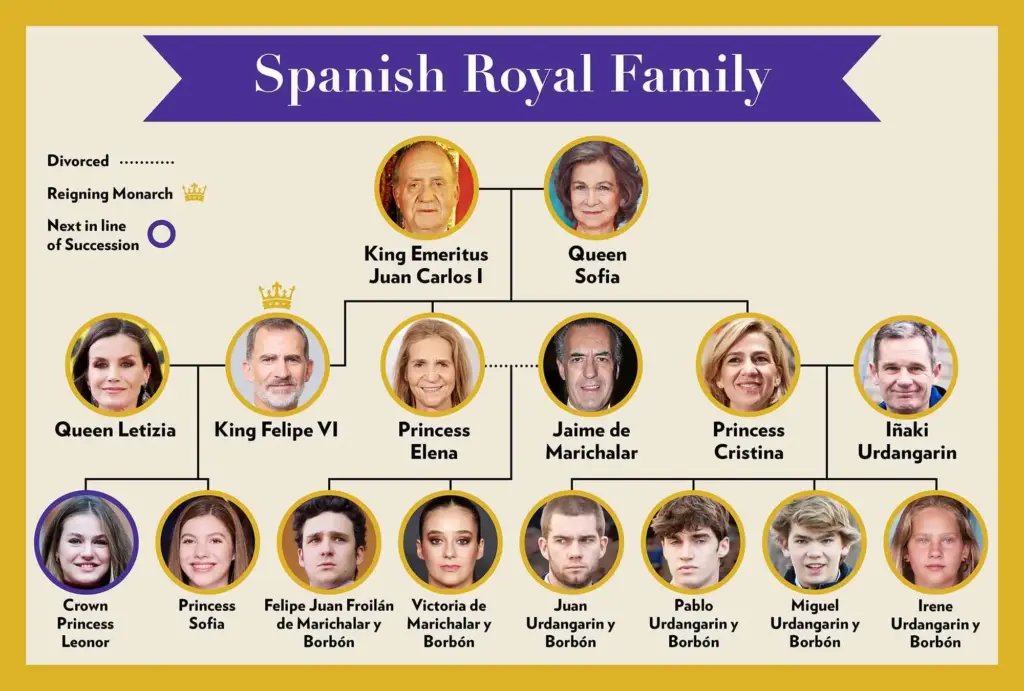
Spain’s line of succession is governed by Article 57 of the 1978 Constitution, which sets out a system known as male preference cognatic primogeniture. In practice, this means:
- Succession passes through the monarch’s children, oldest to youngest.
- Within the same generation, a male descendant would traditionally take precedence over a female one of an earlier birth order, but this only applies when comparing siblings of different sexes at the same level.
- Because Leonor has no brothers, she is first in line regardless of the male-preference clause, since it only matters when a woman would otherwise outrank a male sibling.
- If Leonor’s own children include both sons and daughters, the male-preference rule could someday determine her own successor’s position, unless the law is reformed before then.
This male-preference clause has been publicly debated in Spain for years, with various governments raising the possibility of reforming it to full absolute primogeniture, where birth order alone decides succession regardless of sex. As of now, no such constitutional reform has been enacted, meaning the original 1978 rule still applies.
Leonor’s Formal Recognition as Heir
Leonor’s status as heir presumptive became formally and publicly marked on 31 October 2023, her 18th birthday, when she swore allegiance to the Spanish Constitution before parliament. The ceremony, held at the Palacio de las Cortes in Madrid, is a coming-of-age tradition for the heir to the throne and is widely seen as the moment a future monarch’s role starts to become active in public life, even though the swearing-in carries no formal change in her constitutional position.
The oath was accompanied by Leonor receiving parliamentary medals from both the Congress of Deputies and the Senate. Queen Letizia and Infanta Sofía attended, alongside senior Spanish officials, underscoring how the event doubled as both a family milestone and a state occasion.
Who Comes After Leonor?
The order of succession beneath Leonor currently runs as follows:
- 1. Leonor, Princess of Asturias King Felipe VI’s elder daughter
- 2. Infanta Sofía King Felipe VI’s younger daughter
- 3. Infanta Elena King Felipe VI’s elder sister
- 4. Infanta Cristina King Felipe VI’s younger sister
Because King Felipe VI has no siblings other than his two sisters, and Leonor has no brothers, the line beneath her is relatively short compared to some other European monarchies with larger extended royal families.
What Would Happen If Leonor Became Queen?
If Leonor eventually succeeds her father, she will become Spain’s first reigning queen in more than a century, since Isabella II, who ruled in the 19th century. Spain has had queens consort in the modern era, including her own mother, Queen Letizia, but not a queen regnant holding the crown in her own right since Isabella II’s reign ended in 1868.
Her accession would also make her Spain’s first monarch to have gone through the country’s modern constitutional framework from birth, having been born after the 1978 Constitution and raised entirely within its succession rules, unlike her father and grandfather, both of whom experienced different political systems earlier in their lives.
How Her Education and Training Connect to Succession
Leonor’s preparation for eventually taking the throne has followed a clear, sequenced path: international secondary schooling, three years of military training across Spain’s Army, Navy, and Air and Space Force, and now a university degree in political science. Each stage is widely understood in Spanish media as building a different aspect of the competence expected of a future head of state, with the military training in particular echoing a long-standing tradition in which Spanish heirs undergo service across all three armed forces branches before taking on full royal duties.
Frequently Asked Questions
Is Leonor definitely going to become queen?
Barring a change in the constitutional order or an act of formal renunciation, yes — she is next in line after her father, King Felipe VI, and there is no legal mechanism under which her younger sister would take precedence.
Why does Spain still have a male-preference succession rule?
The rule dates to the 1978 Constitution. Reforming it would require a formal constitutional amendment, which has been discussed publicly but not carried out, partly because reform of the succession clause is considered a change to the Constitution’s most protected sections.
Does the male-preference rule affect Leonor herself?
No. It only affects rankings between siblings of different sexes, and since Leonor has no brothers, she is unaffected and remains first in line.
When did Leonor formally step into her role as heir?
She swore allegiance to the Constitution on her 18th birthday, 31 October 2023, a formal coming-of-age ceremony for the heir to the throne.
Who is second in line after Leonor?
Her younger sister, Infanta Sofía, born in 2007.
Conclusion
Leonor’s position as heir presumptive to the Spanish throne has defined the shape of her life since childhood, from the titles she received in 2014 to the constitutional oath she swore at 18. With no brothers ahead of her, her place at the top of the line of succession is secure under current Spanish law, even as debate continues over whether Spain should eventually move to a fully gender-neutral system. As she progresses through university alongside her royal duties, Leonor continues down a long-established, carefully sequenced path toward becoming Spain’s next monarch.