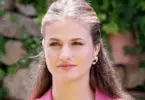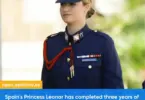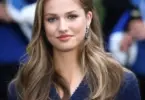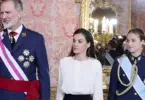
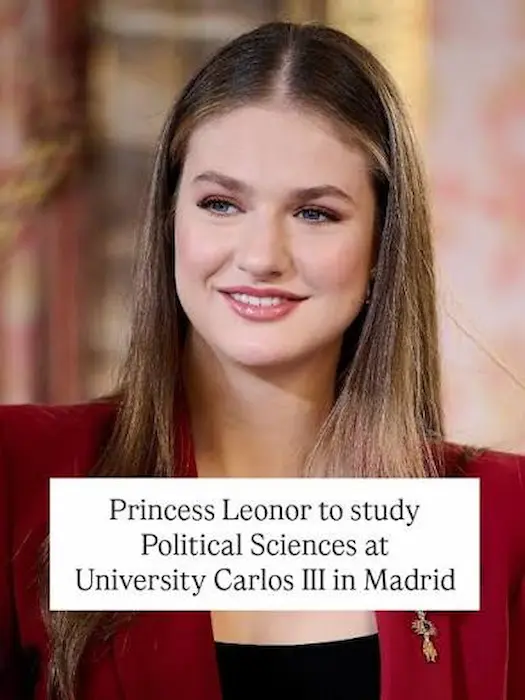

Leonor, Princess of Asturias, the heir presumptive to the Spanish throne and elder daughter of King Felipe VI and Queen Letizia, is preparing to begin a bachelor’s degree in political science this autumn. Coming right after three years of military training, this next chapter marks her return to full-time academic life – and her choice of subject offers a clear window into how the Spanish monarchy is shaping her preparation for the crown. This article breaks down what she’ll study, where, and why political science was chosen over any other field.
Quick Facts: Leonor’s Political Science Studies
| Fact | Detail |
|---|---|
| Full name | Leonor de Todos los Santos de Borbón y Ortiz |
| Degree | Bachelor’s degree in Political Science |
| University | Universidad Carlos III de Madrid (UC3M) |
| Campus | Getafe, south of Madrid |
| Faculty | Faculty of Social and Legal Sciences |
| Length of programme | Four years |
| Expected start | Autumn 2026 |
| Expected completion | Around 2030 |
| Related subjects covered | Law, economics, sociology, history, international relations |
Who Is Leonor, Princess of Asturias?
Leonor is first in line to inherit the Spanish throne, holding the title Princess of Asturias along with several other historic titles tied to the position of heir. She is the elder of King Felipe VI and Queen Letizia’s two daughters; her younger sister is Infanta Sofía. Leonor completed her secondary education through the International Baccalaureate at UWC Atlantic College in Wales. followed by three years of military training across Spain’s Army, Navy, and Air and Space Force, which wrapped up in mid-2026. Her move into a political science degree represents her first stretch of full-time civilian study since she left for military academies.
Why Political Science, Specifically?
A degree in political science gives a future head of state formal grounding in exactly the subjects a monarch is expected to understand: how governments function, how laws are made, how economies are managed, and how international relations play out. Rather than a narrow specialism, the degree is built to be broad, which suits someone whose role will eventually touch on nearly every area of public life without her having executive power over any of it.
This pattern isn’t unique to Spain. Several European royal heirs preparing for constitutional roles have gravitated toward similar fields – political science, law, or public administration – over more technical or narrowly specialised degrees. The logic is straightforward: a modern constitutional monarch needs breadth of understanding across domestic governance, economic policy, and foreign affairs, not deep expertise in one narrow area.
What Does the Curriculum Actually Cover?
Although the degree is titled political science, the four-year programme is genuinely multidisciplinary. Students in the programme typically work through:
- Political theory and institutions: how political systems are structured and how they function in practice.
- Law: foundational legal concepts relevant to the state and governance.
- Economics, including macroeconomics, is often cited by students as one of the harder parts of the course.
- Sociology: the study of social structures and group behaviour.
- History context for how today’s political institutions came to be.
- International relations, diplomacy, foreign policy, and the workings of global institutions.
For someone who will one day need fluency in nearly all of these areas simultaneously, the combination is a natural academic foundation.
How the Degree Fits Her Broader Preparation
Leonor’s path to the throne has followed a deliberate, sequenced structure: international secondary schooling, three years of military training across all branches of Spain’s armed forces, and now a four-year academic programme focused on governance and public affairs. Each stage appears designed to build a different kind of competency, discipline and institutional knowledge from the military and now theoretical and analytical grounding from university.
She is expected to continue carrying out royal duties and public engagements throughout her studies, following the same balance she maintained during both secondary school and her military service. In other words, university isn’t a pause in her public role; it runs alongside it.
What Comes Next?
With her degree expected to run through around 2030, Leonor will spend the next several years balancing coursework with a steadily expanding calendar of official duties, alongside further steps in her military commissions. By the time she completes the programme, she’ll have academic training in political science layered on top of military experience across all three branches of Spain’s armed forces, a combination clearly intended to prepare her broadly for eventually taking on the role of head of state.
Frequently Asked Questions
Why did Leonor choose political science instead of another subject?
It offers broad academic grounding in governance, law, economics, and international affairs – all areas directly relevant to her future constitutional role – rather than a narrow specialisation.
Is this degree common for royal heirs?
Yes. Several other European royal heirs preparing for constitutional roles have chosen similar fields, such as political science, law, or public administration, for the same reason: breadth over specialisation.
Will she continue royal duties while studying?
Yes. She is expected to combine her degree with ongoing institutional commitments, consistent with how she managed secondary school and military training.
How long is the degree?
It’s a standard four-year bachelor’s programme, expected to run until around 2030.
Conclusion
Leonor’s decision to study political science is less about personal academic preference and more about deliberate preparation. The subject’s broad coverage of law, economics, sociology, and international relations mirrors almost exactly the range of knowledge a modern constitutional monarch is expected to have. Paired with her military training, it forms the next clear step in a long, carefully structured path toward her eventual role as Spain’s head of state.